The “Circle of Control” Approach: Teaching Kids What They Can Change and What They Should Let Go
🔒 Secure checkout · Instant download
Description
Help Children Focus on What They Can Change and Let Go of What They Can’t
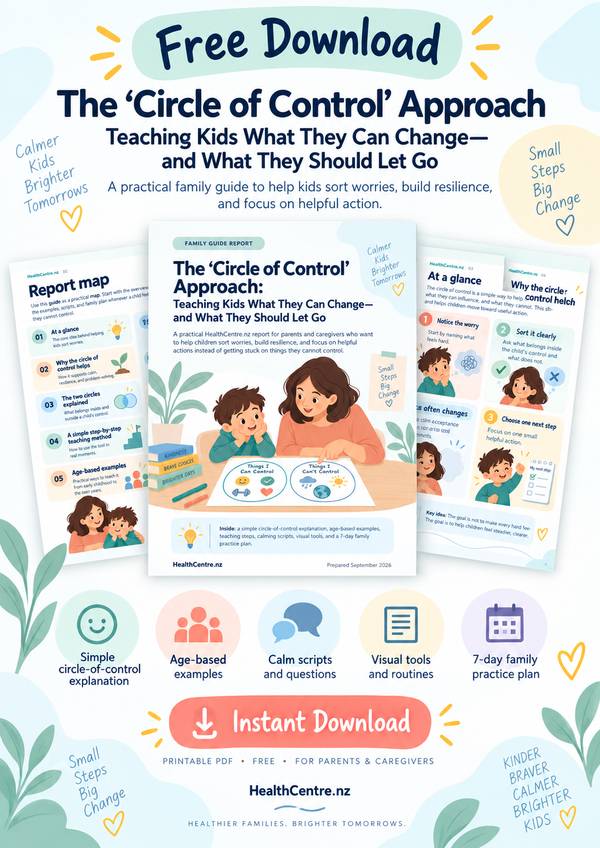
Worries can feel enormous to children, especially when they are trying to solve problems that are simply outside their control. The “Circle of Control” Approach: Teaching Kids What They Can Change—and What They Should Let Go is a practical, reassuring family guide designed to help parents and caregivers teach children a simple but powerful way of thinking about difficult situations.
Using the circle-of-control approach, children learn to separate a problem into two clear areas: the things they can influence and the things they cannot. Instead of becoming stuck on another person’s behaviour, the weather, the past, unexpected changes, or the final outcome of an event, children are gently guided toward actions that remain within their control, such as their effort, words, choices, preparation, breathing, attitude, and willingness to ask for help.
This easy-to-follow guide turns the idea into a practical skill families can use during everyday moments. Children can learn how to notice a worry, sort it into the appropriate circle, choose one helpful next step, and practise accepting the parts they cannot change.
Inside, parents and caregivers will find age-based examples showing how the approach can be adapted for younger children, primary-school-aged children, tweens, and teenagers. Realistic situations include schoolwork, tests, friendship difficulties, sports, disappointment, routines, social pressure, and everyday family challenges.
The guide also includes calm conversation prompts and respectful scripts that can make difficult discussions easier. Rather than simply telling a child to “stop worrying,” adults can use language that acknowledges what the child is feeling while gently directing attention toward practical action.
Visual activities make the concept easier for children to understand and remember. Families can experiment with two-circle worksheets, sticky-note sorting activities, worry jars, bedtime resets, morning check-ins, and other simple routines that turn the circle of control into an everyday coping tool.
You will also discover a straightforward step-by-step teaching method, helpful questions for emotionally charged moments, and a seven-day family practice plan designed to introduce the concept gradually without overwhelming children or adults.
This guide can help children practise:
• Recognising what is and is not within their control
• Managing everyday worries and disappointments
• Choosing constructive next steps
• Developing emotional awareness
• Building problem-solving skills
• Practising calmer responses
• Strengthening resilience and confidence
• Letting go of situations they cannot personally change
The goal is not to remove every uncomfortable emotion or make children feel positive all the time. Instead, the circle-of-control approach gives children a clearer way to respond when life feels uncertain.
Warm, visual, practical, and easy to use, The “Circle of Control” Approach provides families with simple tools that can be returned to again and again.
Small changes in where children place their attention can lead to calmer conversations, more confident choices, and a growing understanding that while they cannot control everything that happens, they can still choose what they do next.
Reviews
No reviews yet. Be the first to leave one.